I am sure when planning a trip with your partner, some of us have a look at the fixtures in any given land and see if you can’t wangle a match whilst away. Obviously, when I am headed to Italy, I endeavour to construct the travel around the places I would love to bring to the FW readership, but that is usually solo travels. Everywhere else, it doesn’t really matter to me. If it is possible, bring it on.
Uzbekistan has long been on my travel wish list. Some 7 or 8 years ago, I asked Tania, my Russian girlfriend if she fancied a trip there. It was a firm no. I hadn’t re-visited the notion until earlier this year, as our travels are limited courtesy of access to the EU etc while the Ukraine war continues to rage. I asked again in the spring, and this time her response was all the more positive, we were going. I referred back to my request years earlier, and she apologised. Even now, a girl of the Soviet era struggles to get her head around the notion that the ‘stans’ (means land of, the Uzbeks, Kazakhs etc) aren’t all just part of the “union” these days. Back in the 2018/19 period, she still had in her mind that Uzbekistan was a dusty backwater. If it ever was, and I don’t doubt her description (no one used to visit was her thinking), it has re-invented itself into a very busy, thriving economy and a very popular tourist destination now. This year it has celebrated 35 years as an Independent nation, but long before the Soviets took it on, this astonishing country was at the crossroads of civilisation. It’s a very multi-cultural society to this day, with everyone pretty much living in harmony. There are elements of society and life here that we could all learn from.
For UK viewers of Race Across the World on the BBC, it certainly might have brought to your living rooms lavish images of a beautiful country. I have been further East to Japan but didn’t enjoy it, largely because the squeaky clean order of the country sits in the opposite corner from my love of organised chaos in South America and Italy. Uzbekistan, though, sat in my mind as potentially my most exotic destination ever. Samarkand, in particular, holds mythical status within me. Central Asia and the “stans” exploration was on, but you can always rely on your partner to pull the mood down, “it’s not exotic for me, just part of the old Soviet bloc” said Tania. I was determined to raise her level of expectation as we went along.
Well at the outset it might have lacked the “wow” factor for her but the charms of this alleged double landlocked country (which is not correct, as only Kazakhstan stops access to the Caspian Sea) were about to cast a spell over us both, albeit, I was captivated before I ever stepped on Uzbek soil.
The post Soviet breakaway didn’t bring any immediate relief for the Uzbeks. Islam Karimov ruled with an iron fist, but despite power merely transferring to his deputy in 2016 Shavkat Mirziyoyev, the contrast in style could not be more stark, and at the last election (every 4 years) he won by a huge majority. Now such results can be scoffed at in various lands where the “contest” is a stitch up before a ballot is taken, but here in Uzbekistan, the strides forward the country is now making has rewarded the President with yet another term to continue the journey. If Uzbekistan was ever a dusty backwater, it certainly isn’t now.
In the first six months of 2026, more than 6 million visitors entered the country, the highest number since records began, with September the start of the high season. That number might start to tail off as winter comes around, but it’s never too cold in Tashkent, boasting 300 sunny days a year.
In September, when we visited, with day time temperatures still hovering around 30 degrees, it’s a very pleasant time to visit. When you consider that Uzbekistan is the most populated of the “stans” with 38 million inhabitants, it seems a lot, but this is a vast and resource rich country. However, in the days leading up to going we did acknowledge that maybe we were just getting to experience the ancient whiff of the Silk Road in Samarkand and Bukhara before the tipping point of tourist saturation kicks in, and the jovial, happy to see you local population starts to lose that sensation as the tourist numbers just overwhelm them, as witnessed in Florence and Venice, and even Edinburgh in the festival month. However, Uzbekistan is a long way from reaching that point. They truly are relaxed and laidback.
My flight from Istanbul was almost a straight line along the Black Sea coast of Turkey, dipping inland just before the Georgian beach resort of Batumi, across the Caucasus mountains, before whizzing across the Caspian Sea into Kazakhstan and then Uzbekistan, with Tashkent almost the postage stamp in the top right hand corner of the country. What was especially dramatic, even from the height we were flying, once over the Caspian, it was endless desert for nearly 90 minutes until the land turned green, and agriculture and businesses started making little settlements, but these sightings were less than 30 minutes before touch down. I had to go away and research it, but the name of the desert is the Kyzylkum, one I hadn’t ever come across before. Uzbekistan has two desert regions.
Tashkent (meaning City of Stone), the capital, surprisingly is only home to just under 10% of the Uzbek population, that said, at nearly 3.5 million it is still a big city, and the traffic will always remind you so. I have never been to a land with so many white cars, it’s quite unnerving at the outset. A job lot sold in one colour, albeit different makes. The reason for choosing white is down to the heat and helps to deflect the beating sun apparently.
Tashkent hasn’t been without its tragic aspects, none more so than a huge earthquake in the sixties, when 70% of the city was flattened with a ‘9’ on the richter scale disaster. Maybe the response highlights the camaraderie of that era, with thousands of volunteers coming from all parts of the Soviet Union to help construct a new city. It only took three and half years to get everyone back into acceptable housing.
Then in August 1979, Pakhtakor, the biggest club in Uzbekistan were flying to Minsk to play a match. An horrendous air traffic control mis-call over Ukraine, saw their plane crash into a passenger jet in the sky. No one survived. I had the great privilege of visiting the monument at the stadium, as well as the spectacular grave, where the entire team are buried together.
The city, sitting in its top right hand corner position, gives Tashkent proximity to Shymkent (means city of wind) in Kazakhstan and Bishkek in Kyrgyzstan. I knew that if I could get the correct vibe for Tania, this won’t be our only trip here, with a little more plundering over these state lines, which is certainly something I would relish in the future.
Once we were all booked, my thoughts turned to the notion that I might be able to catch a game. Tashkent has after all got three top flight teams, as well as Samarkand and Bukhara represented there too. One weekend was lost to International fixtures, seeing the domestic game shut down. Indeed, weeks later, I learned that the national side were hosting Iran in the capital on our last weekend, but the kick off was whilst we were still on a train coming back to the capital from Bukhara, which is a lengthy hop on a fast train. In fact, it seemed as if the dates of travel, always a Friday, had backfired. Not only was that potentially fantastic International lost, but Samarkand were away on our weekend there, and Lokomotiv Tashkent v Bukhara was getting played on the Friday when we were headed out of the capital. However, the Uzbek Cup round of 16 had 4 games scheduled for our first full day in Tashkent, salvation. A local derby no less between the aforementioned Tashkentees, Lokomotiv away to Bunyodkor, at what looked like the incredible Milliy stadium, I had to be there!
Uzbekistan, with all its islamic history and charm, really has managed to preserve the art of feeling as if you are stepping back in time. The Silk Road travellers of yesteryear would be proud that the ancient shrines, castles, and mosques of Samarkand and Bukhara that have been lovingly preserved. They still sit at the centre of these cities just as they did back in the day. The weight of history and nostalgia fires the imagination. Tashkent wasn’t on the Silk Road, and its ancient sights are more encompassed into a modern setting, but that doesn’t detract from the beauty. The Tashkent metro is an astonishing thing too, doubtlessly in this instance a nod to the Soviet era, as similarly stunning metro stops can be spotted in Moscow and St Petersburg etc, should we ever get the chance to go back there.
The ancient sights meet the modern world here, but seeing Uzbekistan invest in a rail infrastructure with bullet trains et al to put us to shame. Other lands just get things done. These trains whisk passengers between the aforementioned hubs, as well as a recently opened line far west to Chiva, another Silk Road delight, but a place sitting quietly on the “next time” roster, as it is a proper old trek even on a fast train from Tashkent.
None of Uzbekistan is far enough “west” to be on the European side of the Ural mountains, the cut-off between Europe and Asia. Kazakhstan lobbied that 20% of its territory is in Europe and its football federation morphed across, having started out in the Asian Conference. Given that Uzbekistan got a first taste of World Cup Finals football, I am always curious if the suits in the Kazakh federation regret that move now. I suspect at International level, maybe, but domestically, now their clubs are getting more used to the lengthy travel and pace of the European game, the money available from UEFA club competitions far outweighs what might be gained from any appearance in the World Cup. Who knows the future, the era of Satpaev and his pals might help the Kazakh cause and see them qualify in the future, made easier obviously if 64 lands get involved, no pressure Italy!
While Uzbekistan is an ancient and enchanting land, ahead of my Uzbek cup encounter, it saw me researching the two Tashkent clubs, and to my great surprise, both of them only started out as clubs this century! The great moniker, Lokomotiv, is such a bastion of Eastern European football from yesteryear. I was convinced they had been around since the Soviet era, only to discover that next February as the new season will just about be thinking of getting under way (March to November season), they’ll be 25 years old. The owners and main sponsors are the Uzbek railways, but perhaps merely started a club as the economy of this newly independent land started to rapidly grow. Back in the day, the only club to scratch the surface of the Supreme Soviet around these parts were Pakhtakor, still the biggest club in the Tashkent, with a fan base that extends beyond the city walls largely thanks to the notion that they were once carrying the hopes of a “nation” in a huge Soviet pyramid.
With Lokomotiv edging close to a quarter of a century of football, I was even more surprised to see the hosts, Bunyodkor (meaning creator), only started out in 2005, and originally as Kuruvchi until 2008. I knew of them under their modern name, and indeed, in their early days, they must have had big backers as they burst on the Uzbek footballing scene with a mind to smash the status quo. It all started in 2008 when they tried to sign Samuel Eto’o from Barcelona, something that eventually failed, but Andres Iniesta, Carlos Puyol and Cesc Fabregas all visited Tashkent with a view to discussing moves, but they all decided to stay in Spain.
The ambitious board weren’t to be outflanked and turned their attention to Brazil next, managing to sign Rivaldo, who stayed from 2008 to 2010, and was managed in that period initially by Zico and then Big Phil as he was known, Luis Felipe Scolari, another Brazilian. Pressure was on them to perform in the Asian Champions League, but a Quarter-Final defeat to Al-Hilal in 2010 saw Big Phil resign, and Rivaldo terminated his contract a year early. They did make the semi-final stage in 2008 and 2012 of the AFC Champions League without the Brazilian influence.
Subsequently, while the national side has started to finally realise their potential, Uzbekistan has probably come to terms with the notion that it cannot compete with the petro-dollar states in the Middle East, who are always grouped with them each and every year in the Champions League, due to a regionalised group stage, (Japan, South Korea, China and Australia are the hub of the other region), making winning this prestigious gong further away than ever.
Perhaps that realisation has seen Bunyodkor slip away from the heights they aspired to in those early years. Talk about hitting the ground running though, in 2006 their only second tier experience saw them promoted as champions, and after finishing runner up in 2007 in the top flight, they would win 5 out of the next 6 titles in the top league, taking us to 2013. In the same period, they also won 3 Uzbek cups, too. Bunyodkor haven’t won either since, with merely two second placings on a roster of finishes with a heap of mediocrity involved that is starting to point to a side, just happy to make up the numbers. That said, judging by the numbers of managers they go through, someone still holds on to the past and hoping. Even Pakhtakor aren’t getting things all their own way again. It is a very competitive league, with Neftchi Fergana, from the rich green land on Kyrgyzstan border presently leading the way.
Amidst Bunyodkor’s rich vein of success, a brand new stadium was commissioned in 2009. It opened its door in 2012, just in time to see at least one title success the following year. It holds 34,000 and is the biggest football venue in the country. The Uzbek national side also plays here as well as the local side. The Milliy Stadium is an architectural gem, a two tier stadium all the way around with lavish hospitality suites built in, but a game under the lights with the stadium lit from the outside, it adds a little something to this very impressive arena. It was a privilege to get to see a game here.
If Bunyodkor are on the slide, Lokomotiv have been in the mid-table space or lower for a number of years, too. Yet, it was the railwaymen who took up the baton of success initially as the Bunyodkor star was starting to wane. The club’s three Super League titles came a decade after starting out, 2016/17/18, perhaps taking a more traditional, building a side worthy approach towards success. They have won the Uzbek Cup three times, too, 2014/16/17, with the last two, essentially the double. The wobbles have, though, seen three second tier titles, with successes in 2023 and 2025, getting them back into the elite league. It all pointed to two clubs needing the cup to save their season with Neftchi Fargona and Pakhtakor fighting it out for the title.
These two Tashkent sides should trotted out on a warm Tuesday night for the cup action at the Milliy with Lokomtiv fourth and alarmingly the hosts Bunyodkor being 19th out of 20, albeit a mere point from safety and 17th place, but the games are running out, just 9 games to go.
Getting to the Milliy is easy if you download the local taxi app. The Uzbek equivalent of Uber, and it works brilliantly. That said, arriving at 8am, six hours before I could get access to the hotel room, and 12 before Tania landed, in excessive morning heat, I decided to pace out the near seven kilometres for field reconnaissance. Having had merely 30 minutes dosing the night before, it was a tough walk. Relatively flat, but I was knackered by the time I got back to the hotel.
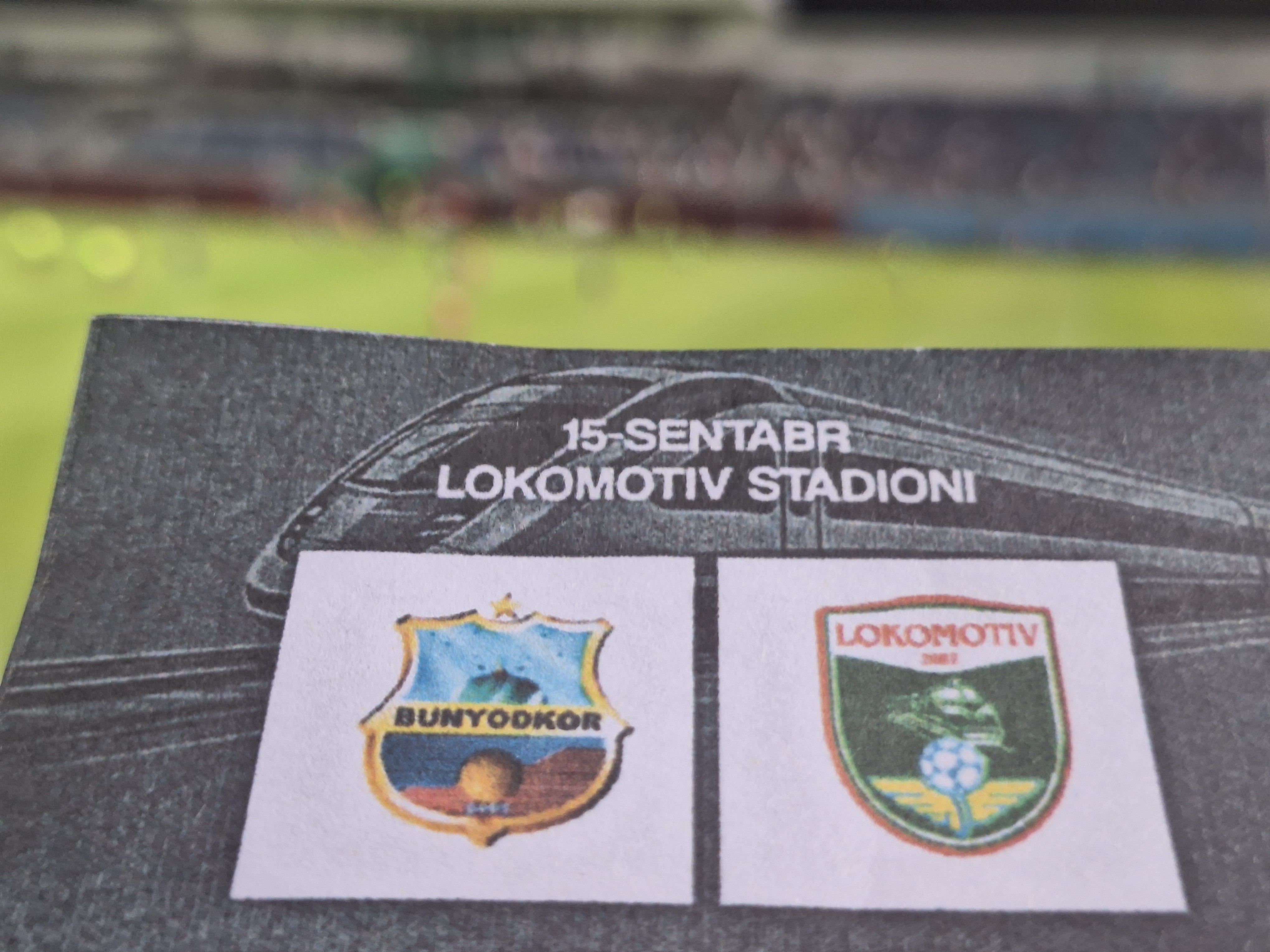
What subsequently transpired are stories of frustration and downright stupidity, whether on my part or Bunyodkor, I am unsure! I arrived at the Milliy 35 minutes ahead of kick off. It was all locked up?! I asked the gate man, to learn that the game at been flipped and was being played at the Lokomotiv stadium. Lucky white heather, not, it was 22 kilometres across a very busy city at rush hour. Although, it’s a busy traffic city 24-7 in Tashkent.
Needless to say I missed a whack of the first half, but with this amazing local taxi app, three taxis, and having inadvertently paid 10 times face value for the ticket, (I was in a hurry) it had merely cost me £30 all in! The currency is slightly nuts, with 1 million som being £62. The zeroes get lopped off, so “2” was interpreted as 200,000. Only when sitting admiring the rarity of a match ticket in the stadium, did I realise that it said 20,000 on it! Truly an unfathomably cheap ticket!
My scoping of the Milliy (means National) had been for nothing, but conversely I had seen all three stadiums of the big trio on one journey! I always have positive spin for everything. The Pakhtakor stadium is especially Soviet, with iconic floodlight pylons that wouldn’t look out of place at the old Zenit stadium in St Petersburg. It is the most central venue.
The Lokomotiv Stadium, in keeping with a new club, is a very modern and clean. It is relatively compact (8,000 capacity), oddly in the Bunyodkor area of the city! Sadly the World Cup qualification doesn’t seem to have got many extra bums on seats, unless the 18,30 kick off and the fact it was a cup match detracted from a bigger crowd.
The only goal of the game was missed, of course, but seeing the highlights later, it was a blatant tug of a shirt by a Bunyodkor player, with a well despatched penalty for the ‘hosts’. With this being a cup match however, it had an end to end quality. Quite how neither registered again remains a mystery. The Loko keeper had some great stops to keep out Bunyodkor as they pressed for the equaliser. It’s an old cliche, but when you are near the bottom, your luck always seems to be out, and that was the case in this one. I had hoped for extra time to offset the lost game time earlier. However, I was glad that I made the journey. It was a very nice experience. Like everything here in Tashkent, it was very relaxed and laidback. Too much so maybe, Bunyodkor never posted anything about venue change!
I truly loved my visit here. It is going to see my return for sure. I am converted to the joy of Uzbekistan.

