The fifth tier is always a competitive level in any given nation’s ladder. A holding pen for some of the great sides of our youth who have fallen on hard times, either through periodic dribbling away, or the grand old snake of mis-management. These clubs clash at this level with those of an altogether new world construction. In a nutshell in England, those three descriptions could be encapsulated by Southend United, Scunthorpe United (both of whom have nibbled at the Championship end of life) and Boreham Wood, whose continual knocking on the door of the Football League must at some stage either happen or they just plainly give up.
In Scotland, the fifth tier has only really become a thing just over a decade ago. Leagues existed outside the confines of the SPFL, but there was no access unless they were expanding or someone had gone to the wall, thankfully, something that has infrequently occurred. In 1994, Caledonian Thistle (Inverness was added later) and Ross County were voted in, while in 2000, Elgin City and Peterhead also joined, making it a veritable Highland clearance of five stalwarts at that level. In 2008, Annan Athletic were the last to be voted in, this time from the south, before the Team 42, the club bottom of the heap started requiring a play-off to survive. In 2014/15, Montrose were the inaugural league participant, surviving against Brora Rangers, who had seen off Edinburgh City to have the right to a stab at league football.
A curious quirk for poor Elgin, who were one of the most successful sides in the Highland League over the decades, but as a club, 134 years on, they remain a team who have never experienced promotion (or relegation, granted)! Is there any other club, anywhere in the world who have been going that long, who have never had the joy of stepping up (or down) without being “voted” up as Elgin were.
The same can perhaps be true of the Highland Leagues latest recruits, Invergordon, although technically the North Caledonian League is now a sixth tier feeder to the higher level, along with the North “juniors”, who hail largely from the Morayshire/Aberdeenshire part of the north. By and large, none of these clubs have either the ambition or the stadia to step up, but the option is available should the desire for growth start to formulate in any given boardroom. Fort William, cult club as they were (perhaps still are) remain the only Highland League club to lose that status thus far, and are continually trying to get back, but while they are no longer the whipping boys, they have never managed to mount a serious challenge to date.
Invergordon have been perennial NCL winners in recent years, and while they might have normally needed to go through a play off with bottom club Rothes to step up, Brechin City from Angus, an ex-league side who never really felt part of the establishment in the Highlands, decided to upsticks, and move off to the Lowland League East this term to try their luck going forward via that route. Many old league encounters with Berwick Rangers, East Stirlingshire and Cowdenbeath await City here. I will refrain from getting started on why the Lowland set up now finds multiple “promoted” sides in the newly established Lowland League West. Team 42 next May will face off against the winner of a three way round robin play off between Lowland East, West and Highland, but even then, only if the club has the correct paperwork, which seems more important than having the necessary capacity and facilities that could be classed as sufficient, Edinburgh City and East Kilbride being case in point, with woefully inadequate capacities.
Just establishing themselves in the Highland League will suffice for Invergordon this term, but a creditable draw at Fraserburgh on day one was a signalling of both intent and no lack of ambition. They might have narrowly lost the next two games, but a first win in game four versus Deveronvale at home, and away at Wick added to the notion they’ll be more mid-table than struggling. We are hardly about a revolution, but a side from the Ross-shire end of the “Highlands” was much needed, as the more recent inclusion of Cove Rangers (now a league club), Banks o’Dee, Formartine United, Turriff United and Brechin themselves was badly weighting the league towards an Aberdeenshire set-up, and the natives from further west and north weren’t too happy.
If you have ever undertaken the trek along A96 from Aberdeen west towards Inverness, you’ll know it is a very stop, start, and awful road. It is also amongst the most accident prone routes anywhere in the country. A Wick to Banks o’Dee (Aberdeen) match, or vice versa, is a tortuous route, with Nairn and Elgin, both bottleneck towns from the increasingly voluminous traffic. The inclusion of Invergordon will be welcome news for Brora and Wick in particular, with just one less lengthy bus ride every season.
Brora Rangers, last season’s champions have largely been at the top end of the Highland League for more than a decade now. It is all the more remarkable when you consider the population of the village is little more than 1,200. Invergordon, with its 4,000 plus is a veritable metropolis in comparison. Clubs at this level need to be well run and have good backing to stay in the vanguard, and these are certainly two strengths at Dudgeon Park, home of Brora, not to mention all the trophies they’ve wracked up. Invergordon as a club has huge potential as the son of Ross County chairman Roy MacGregor, Alistair is at the helm. His fathers business sense and guidance will certainly make sure the club doesn’t fail. Indeed, as dad despairs of all the money he annually writes off to keep Ross County viable, perhaps the MacGregor family’s next project will shift towards coastal Ross-shire and away from Dingwall entirely? It’s not outside the bounds of possibilities. Ali has a noticeable disability, but being made chairman of Invergordon will undoubtedly assist with raising his confidence, and getting him involved is a terrific thing.
As a town, Invergordon grew up around its deep depth harbour, which was once a naval base, but whose sheltered waters today make it the stepping off point for cruise ship visitors, many of whom will be immediately whisked off on tours to Loch Ness and Inverness etc. There were two in port on the day I visited, and those who chose not to head off to see the sights were certainly adding to the coffers of the local shops in the main street. The sight of a huge cruise ship down a tight wee alleyway in a Highland village is certainly an odd thing.
The population doubtlessly was swollen in the ‘70’s when an aluminium smelter was established. A government initiative back in the day to try and incentivise business in development areas to arrest the increasing migration of people away from smaller Highland places. Despite the subsequent closure of that facility, the close proximity of Nigg and its oil installation work, now largely morphed into the renewable energy world (where the MacGregor’s and Brora owners make their money), will all have helped keep people in the vicinity and gainfully employed. A modern day development area exists again stretching from the Ross-Shire coast right down to the Inverness harbour area by way of encouragement to increase business opportunities and production in the renewables sector. Slightly controversially the reclaimed land where the Caledonian Stadium sits, home to ICT, had originally been in the development area, but has been withdrawn. A situation that didn’t help the club raise funds from left field activities when the money was really needed. Petty business jealousy is rife in this part of Scotland.
Recreation Park (now re-named the Ali MacGregor stadium) has been increasingly buffed up in recent years in preparation for the chance to step into the Highland League. Its capacity of 1,000 is more than sufficient at this level, but exceeds the ability of K Park, East Kilbride to house a crowd, and they are now in League One, the third tier of Scottish football! Those who continue to play in the North Caledonian League, with the exception of Golspie Sutherland (long affiliated to the SFA, and hence always involved with the Scottish Cup) and Fort William, the rest use pitches that might have a rope around them to distinguish themselves. Orkney, the island grouping just north of the mainland has a team in this league, and last season they played in St Mary’s, right at the end of the last Churchill Barrier as you come north off the ferry from St Margaret’s Hope. It was a fabulous venue with natural terraces in the surrounding grass. Whether it was too far from the large metropolis Kirkwall (it was only 7 miles away), I am unsure, but they have reverted back to a cage at the back of Kirkwall grammar school, sadly. I refuse to watch a game in a cage.
You certainly don’t want to step out of line in Invergordon, as it is home to Luke and Tom Stoltman, who between them have been winning a large number of UK, European and World Strongest Man Titles. The fame of the brothers means that they get a nod on the ‘Welcome to Invergordon’ sign as you enter, not forgetting the Stoltman shop in the main street. These guys have a cult following, obviously. On a more niche Scottish football commentator front, Rob MacLean is a local lad, as well as Bryan Gunn, the Scotland goalkeeper.
Buckie Thistle were in town for this Highland League encounter. A side who have been champions in recent years and had one especially brilliant cup run that took them to Celtic Park in round 5. They have also participated in the Scottish League Cup groups and Challenge Cup courtesy of high finishes. It certainly led to one of the more curious fixtures in Buckie when they hosted Linfield from Belfast, when the latter cup competition had “guests” from all corners of the UK and Ireland. Oddly, The New Saints made the final one year and that “unusual” aspect of this cup then fell away. I am sure most readers will be aware there is an unofficial affiliation between The Rangers in Glasgow and Linfield, certainly between the fans, and while Buckie have no connection with Celtic, their kit (originally gifted apparently) is identical though, adding an Old Firm illusion to this Highland League versus Northern Irish League clash. For the record, Linfield won 2-1.
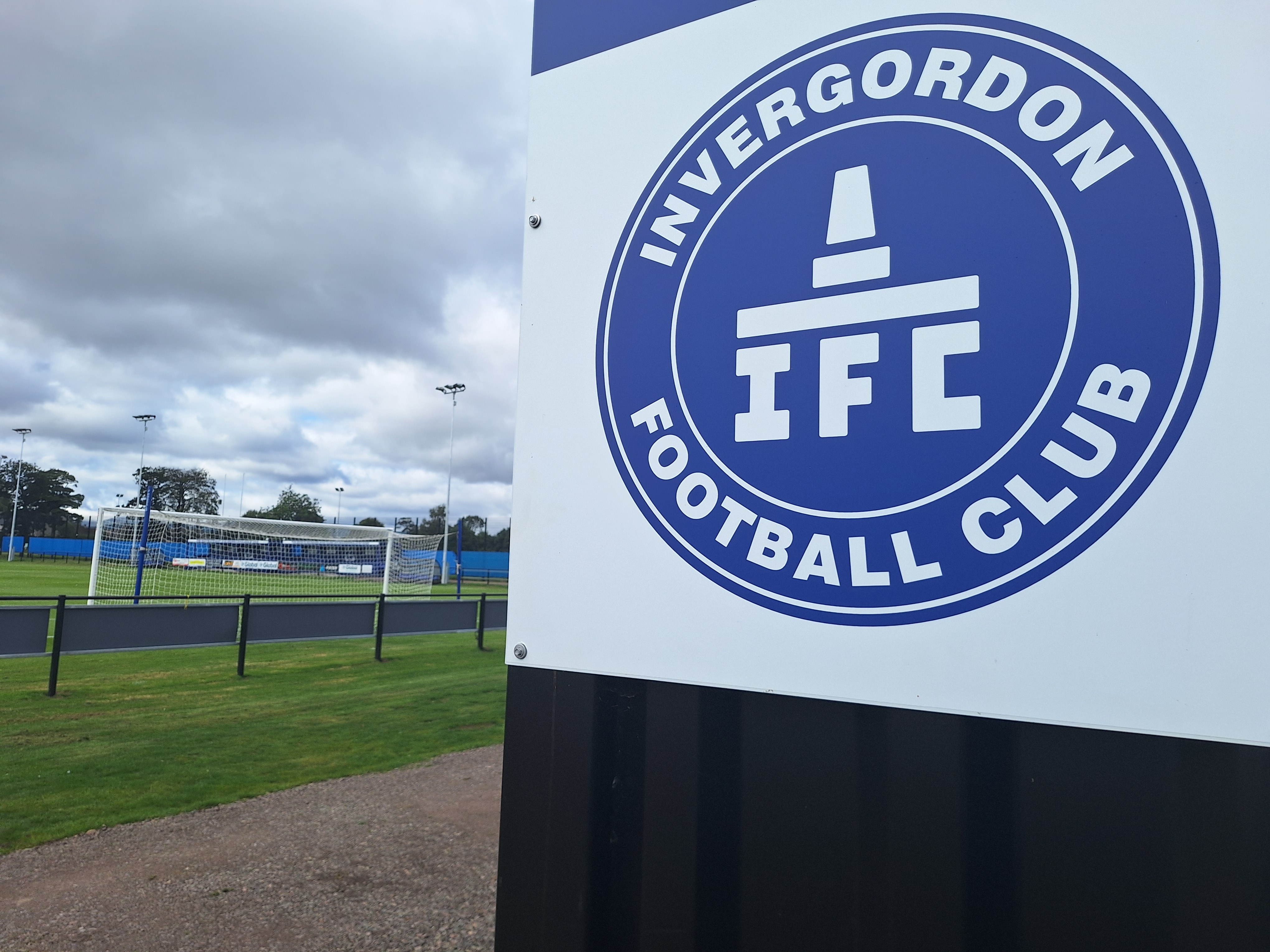
The ground is in a vast recreational area not very far from the village centre. It is no more than a 10 minute walk from the main street or the railway station. You will see the main church from pretty much any central point, with the road providing access to the ground just up to the left of here, then along a narrow path at the side of the rugby pavilion home to Rosshire/Sutherland Rugby Club. Invergordon FC has a modern and more than adequate changing room facility, a hospitality unit, as well as catering, etc. There are two small stands, maybe allowing for around 130 seated. Three sides are open for standing, with one “cage” side. Curiously, on a day when Ross County were at Airdrie, their Chairman was here, along with his son (more understandably), as well as Don Cowie, now youth development coach at County (five of his boys are on loans here). I had the great pleasure of presenting Don with the ICT Supporters club player of the year award nearly 20 years ago on the pitch before an end of season top flight match versus St Mirren. I scrolled and scrolled through my phone to find the photo from that moment, ahead of going over for a wee chat and amusing him with the snap.
Having suggested earlier that Invergordon will be just fine in the Highland League, coming up against their first title contender was maybe a stretch too far. Certainly things weren’t helped with the news that their best defender wasn’t available as he was off playing shinty! Going forward, maybe that aspect of his sporting roster might need revision, but welcome to the unpredictable and wonderful world of the Highlands. For those unfamiliar with shinty, it might be best described as a whole lot more dangerous version of hockey.
Buckie weren’t world beaters in this one, even if 0-6 suggests they might have been. The scoreline flatters them, but you can’t fault the clinical edge they showed. Amongst some good goals were a couple of stinkers, one borne of a stramash (a great Scottish word for a melee). Invergordon created enough chances to have at least made the scoreline more respectable, but the Buckie keeper was in cracking form, as well the local shooting range being slightly off. Had they mustered a couple of goals here, no one would have complained. Invergordon will have better days, but when you are playing one of the top sides, make sure it doesn’t clash with the shinty!
Finally, the tables are starting to turn in the Highland League. It’s a curmudgeonly old school level, where change happens at a more leisurely pace. That is exactly in keeping with the warmth of a Highlander. City life can learn from the more sedate and welcoming pace up this way.

