The diverse and large region of Abruzzo might not be amongst the hotbed areas for calcio, but it certainly packs a lot in. From mountain ski resorts to lengthy coastal beaches, as well as terrific historical towns, it’s just about got it all. The big fish is the capital Pescara, maybe the only club those not immersed in Italian football could immediately trot out from Abruzzo. I have written about Pescara and her team previously. However, a weekend sojourn, towards the end of the season, was going to be entirely more niche, but would you expect anything else from your writer?
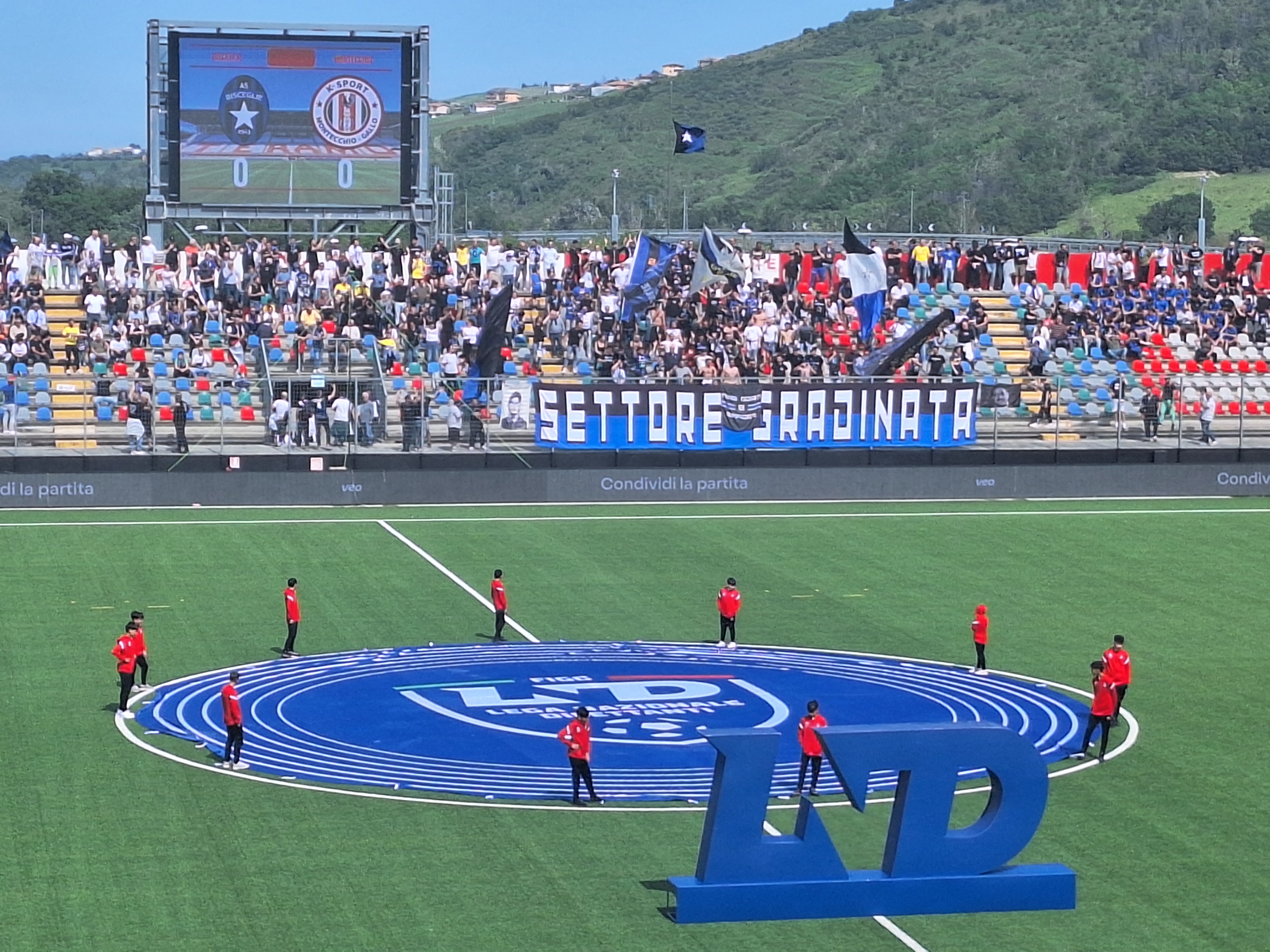
The key driver to one last trip to Italy for 2025/26 was the Coppa Italia Eccellenza Final (tier 5-The FA Trophy equivalent if you will) which was being played in Teramo in the Abruzzo region where my “wee” Italian side AS Bisceglie had reached the final. I had already been across to see my “big” Italian side (they’ll both be in Serie D next term!) Ancona, who lost the Coppa Italia Serie D (tier 4) to Pistoiese in March. With my Scottish team, Inverness Caledonian Thistle collecting the League One title, your glory hunting correspondent was still craving more silverware from a unique trio of events!
Cup competitions in Italy are quite odd. The main one, the Coppa Italia, features all of Serie A and B, plus a limited number of high finishers in C. It’s set out like a nauseating tennis ladder, seeded to within an inch of its life, with the early rounds played in August when they largely are just glorified friendly matches to the smaller sides involved at the outset. No one really gives a hoot until maybe the last 8, by which time we are almost certainly into an exclusive Serie A selection. Curiously, Ancona in 1994 were the last non top flight side to reach a final, and Alessandria, a third tier team at the time, were the last small team to reach a semi-final a decade ago now.
This is the only cup competition open to sides in A and B. Serie C has its own competition between the 54 sides at that level. Winning the trophy gives the successful club a serious leg up in the end of season promotion play offs. Potenza claimed the gong this season and while finishing 10th would normally see them enter in round one, they can skip two rounds and get involved in the third round instead.
Serie D is a much bigger beast, with nine leagues of 18 clubs, but also has its own competition that starts off regionally, then opens into a national competition, culminating in Ancona losing both legs to Pistoiese as previously intimated. I had started the season at Citta di Fasano v Gravina in Puglia’s second round (an FW feature), so it was fitting to see it through to the end.
Indeed, in the same article about Fasano, Brindisi v Taranto was included, and all the farce that went with this tie. That was round 1 of the Coppa Italia Puglia, at the Eccellenza level, a competition which Bisceglie eventually won, edging out Taranto in the final. That then meant that the White Stars as they are known, entered the national competition “southern” section, playing three rounds (2 legs a time) versus sides from Campania, Calabria and Lazio (dramatically on penalties in the semi) to progress to the final against the winner from the “northern” area, albeit this term, a team from Marche, in central Italy, just north of Abruzzo. The small villages of Montecchio Gallo combined were the opposition. They had conquered the mighty Alessandria in the semi and also won their league. This aspect was crucial, as Bisceglie finished a distant second to Brindisi, who went unbeaten all season in the Puglian league despite being thunderously dull. However, playing a team who were already promoted in the final meant Bisceglie were going up, too! This final was just going to be one big party and perhaps allow for a more relaxed approach, but both sides would want the accolade of the cup win.
Sitting well off the coast with the mountains of Gran Sasso D’Italia behind it, Teramo is the small regional capital with a population 52,000. It sits at the confluence of two rivers, with the terrain and climate in the surroundings making it the centre of high quality vines. Abruzzo is famed for its wine production.
The name Teramo (pronounced Tera-mo, said very fast, almost to the point that the ‘a’ is redundant) comes from manuscripts back in the day where it was called Teramne, but seems to have also carried the name Aprutium, as documented by the Geographer of Ravenna! Now that’s a grand title! The Normans had a hold of it for a while, then two local families squabbled over it in the Renaissance period, with 13 members of the Melatino family to this day commemorated in the city shield displayed in the centre of town. The Spanish came and conquered, but sold the city to the Duke of Atri, a chap the locals obviously didn’t like as it sparked a huge rebellion. Amid all the anger and squalor, an earthquake hit, and then the plague, no luck whatsoever!
Napoleon took ownership for a while, before the King of Naples brought it under his wing following an arrangement with the French. Things all calmed down when Italy united and became a country, but this is, even today only a reality on paper in truth. Italy is a very fractured land. In 1925, perhaps given all that went before, Teramo was home to the first Italian Psychoanalytic Society, with couch conversations becoming a thing as people got all that trauma out of there system.
There would be one last troubled passage of angst, when the Germans arrived and soon departed after the resistance saw them off at the Battle of Bosco Martese. Once all had finally calmed Teramo hosted the first ever Handball World Cup in 1972, and opened its now prospering University in 1993.
It’s a very classic Italian centro storico, albeit more cranes and scaffolds presently than seems vaguely right! The centre is a good distance further up the hill from the train station. Over a very high bridge, through the old city gate, and yee olde worlde Teramo awaits. It’s certainly worth a peek if you have time, but be aware that the stadium is nearly 6 kilometres back down the hill, with Nepezzano the nearest stop, more later.
In a footballing sense, the local side are a somewhat sleepy affair, reaching Serie C occasionally is as good as life gets. Ancona in particular has a beef with the Abruzzo side courtesy of recent events on the pitch. In 2014, I was at Del Conero on a very sad night, when Teramo condemned us to fourth tier football (we ultimately went further down due to bankruptcy) amid volleys of smoke bombs and discontented home fans. The name Teramo was etched, née seared into my mind, I had unfinished business with this mob! I hatched a plan to head back to Ancona to see these two play in April this year, when our paths crossed once more. Alas, the occasional lunacy of Serie D sees matches played at 3pm on a school day, and with my buddy working almost until kick off and the stadium many kilometres from the city, with no specific buses running out there, I decided to head elsewhere. Maybe just as well, Teramo won again, a result that scuppered our promotion dream once more.
Right at the start of the season, when visiting San Benedetto Del Tronto, game two of my Italian campaign was meant to be the heated local derby of northern Abruzzo between nearby coastal upstarts Giulianova and Teramo. They hadn’t played each other for many a year, therefore the demand was high and the local authorities, despite not allowing away fans, weren’t for opening up the away sector for home fans, another mad decision from Italian bureaucracy. Details of when tickets would be available were both slow and non-existent. The promise of the remaining briefs going on sale in a nearby outlet never materialised online, so we gave up and de-bunked to Pescara instead. For the record, Teramo gave their coastal upstart neighbours and newly promoted rivals a real thrashing 4-1. Literally, no one in the ground, save the Teramo staff, would have been thrilled by that result. Given the pretty terrible communication and selling tickets without letting the social media platforms get involved was pretty shabby in my book. I smiled at the result.
Despite all this, Giulianova was where I decided to base myself for the weekend. It’s a lovely beach resort town, from where a local train is headed inland and upwards to Teramo, taking a mere 20 minutes to zip up the hill.
With a 15,30 kick off, setting off at 8,40 am from Cesena, after witnessing an absolute belting 3-4 loss to Padova the night before, even with the early start, was still a tight trip timewise. It became bordering on tricky upon arrival at the station for my first train, when the departure board told me that the Ancona bound train was minimally 90 minutes late. Subsequent connections would all be lost.
Italy has in recent years caught me out with missed connections, cancelled or striking services et al on a number of occasions. I shudder how much money I have forked out to get things back on track. But this is my land, and I forgive it almost instantly, despite my immediate angst. In this case, ala Race Around the World, I needed a taxi to Rimini, where I could jump on a fast train. It worked, but at a cost, and if I was playing the reality TV show, I would need a home stay to re-coup my funds, otherwise I would be out. I also had to employ a Giulianova taxi to briefly take me to my hotel and back to the station.
The final drama in this saga is, the trains heading up the hill towards Teramo, for some reason, on the outward service from Giulianova, skip Nepazzano, the stadium stop. You can wave to the stadio from the left side of the carriage, but essentially you need to go 4 minutes further up to Teramo, wait a bit, then the same train head down, stopping at the requisite stop. Make sure you have 2 tickets. Otherwise, you might get fined. The conductor caught two fans out in the short return down the slope on this very point.
From Nepezzano station, its down to the left for about a kilometre, around a new shopping centre, then the Gaetano Bonolis stadio awaits. Having set off at 8,30 from Cesena, I made kick off with 15 minutes to spare, and no change from an additional £150 for all extras to make it happen. We only live once, and I was not missing Bisceglie in this cup final for anything!
The Bonolis is a very well appointed modern stadium. The main stand is magnificent, affording views across the hills. I decided on being in this area across from the core of the Bisceglie fans, partly for the photos I could take, as well as catching up with Francesco and Donatella, my White Star media chums. This was my 100th stadium in Italy!
For an hour of the match, Bisceglie were the better side. They were creating chances, but just unable to find the opening to get the crucial first goal. Alas, a last man red card saw us reduced to ten men on 60 minutes. This emboldened Montecchio Gallo, who created a number of opportunities through the rest of the match and the first half of extra-time. They will look back at some incredible misses, but also, they were also thwarted by some great goalkeeping too.
Bisceglie kept fighting, and as Montecchio became more desperate, counterattacks were starting as the game got more stretched. Then, maybe 6 or 7 minutes before penalty kicks, Lopez found himself one on one with a defender, complete with loo roll attached to his ankle! He cut inside and unleashed an unstoppable strike into the bottom right corner. It sparked almost headless joy in me as I ran along the empty row of seats like a dememted man. The joy, then the emotional hugs with my Bisceglie buddies. The ten men were close. Montecchio poured forward, but in truth, Bisceglie had two more great opportunities they spurned. The final whistle went, Bisceglie Campioni! They had won this trophy 14 years ago, too, beating Pisa in the final of that edition. They’d done it again.
This was more than a cup win, the city has been dragged into a mafia war spilling out from Bari. Two people have died recently. It was also more poignant as the club President was diagnosed with a terminal illness just two weeks before. He was unable to attend the match. This was for him. Two issues that someone not attached to a club wouldn’t know. It added depth to the whole occasion. I am glad I made it.
The plan the following day was to go to Chieti for a big 4th tier relegation play out. However, a couple of days before (having bought my ticket), this game was postponed. Chieti are being investigated for wrong doing, and their position in the final table might be altered. With little or no alternatives nearby, and having missed the city of Teramo anyway, the next day I headed back up that way, for a Serie D “promotion” play off semi final being played in the same venue. I think it is the first time in my life I see two games in the same stadium on consecutive days. It was really celebrating the 100 stadium gig well!
I put the word promotion in inverted commas because in truth winning the 9 play offs merely puts them in a ranking table for potential promotion if a space arrives. But with the modern obsession of get Serie A U23 into Serie C, the chances are more remote than ever, sadly.
If you happen to be in the area and heading up to Teramo on a Sunday for a game do take note, the train service becomes very limited. No train back down to the stadium co-ordinates even vaguely with a game, and the post match wait, if going back to the coast is 2 to 3 hours after the match. A shopping mall is all you’ll have for entertainment. With no bus (utterly preposterous in truth), I walked the 5.5 kilometres from Teramo to the stadium. It’s lumpy, with lengthy parts having no pavement, on a very busy road. This is not recommended for all.
For the record, Teramo hit a 90th minute winner to go to the play off final. It should have seen them back in Ancona, who finished second in the table, but we lost to Notaresco, another Abruzzo club just down the hill from Teramo. They are two small to be a big rival it seems, that accolade is reserved for Giulianova. The fascinating joys of lower league Italian football. It is never dull.

