Heading back across the Straits of Messina onto the island of Sicily by train is always entertaining. Yes, it’s time consuming as they shuffle the engine and carriages on and off the boat, but once all are inside the bowels of the vessel, you can stretch your legs and get a blast of sea air as it crosses the narrow passage of water separating Reggio Calabria (on roster for a visit next season), and Messina. My trip would continue down the eastern side of the island, passing Taormina, the most famous holiday resort on Sicily, before pitching up in my host city for Easter, Catania.
This would be my third visit to Catania, but my first opportunity to actually see a game in the city, having seen Catania away a bunch of times. Invariably, they end up in a 2-1 loss for Gli Elefanti (the elephants, one of the club nicknames, more soon!), with the exception of a 2-1 win at Pescara last term in the playoffs, but ultimately they had lost 0-1 at home and were out courtesy of a lower league placing (a good rule that one for a tied aggregate).
I guess when we book trips, maybe weeks, if not months in advance, there is always the hope that something is riding on the outcome of the chosen match. Indeed, this particular expedition was booked prior to my last visit to Italy, which became a hastily arranged gig at 4 days notice courtesy of the outbreak of war in the Middle East curtailing a trek in that direction. Can you believe it, I was actually going somewhere else, and not even to see any football whatsoever. If I knew nothing of the game in any given land, I certainly wouldn’t bother going. It is pretty much my mantra. Getting ticks and counting lands/stadia certainly does not exist in my world, I need to feel engaged. I have a low sphere of intrigue outside Italy.
Anyway, with the UAE airspace closed and the flights and hotel refunded, I found myself with 12 days in the diary blank. Thoughts immediately turned to Italy for a wee trek, cobbling together a six day break, complete with hundreds of kilometres of travelling all arranged for three games of football and some culture. In the winter, the direct flying schedule to Italy from Edinburgh is restricted to Milan and Roma, with the latter an eye watering price at such short notice, so I plumped for the more northern arrival option.
The main draw for me was the Saturday night fixture in Ancona, the second leg of the Coppa Italia Serie D Final versus Pistoiese. Framing some sort of side card to this final at short notice saw me lured with great delight back to Benevento. It was a month prior to my scheduled trip to Catania, but by delightful coincidence, these two sides were top of the table with just one sole automatic promotion slot up for grabs.
The trek from Milan is a fair old stretch to Benevento, but with the aid of fast trains, a mere 5 hours (ended up 6 plus) sat on a couple of trains, and I was easily in the town well ahead of kick off. Alas, in the preceding days, yet another dreadful sign of regional authorities going overboard in Italian football (especially in the south), less than 48 hours before the match, any Catania fan living out with Campania were banned from attending. This was truly disrespectful. Catania had sold 1,400 tickets, and also, every one of them would have spent money on travel, as well as potentially accommodation with a 20,30 kick-off a long way from Sicily. The rationale was that local police feared Catania fans would run into Cavese Ultras on the autostrada (motorway) en route back from Crotone. Such a scenario occurred in the autumn when the Catania tifosi had a fight, quite literally on the motorway with Casertana fans who I had been with in Picerno that afternoon, headed in the opposite direction. This unfortunate clash doubtlessly gave them the excuse to pull the plug, but why so late. It’s all very sad and it undoubtedly helped Benevento get over the line in this crucial match, winning a terrific game 2-1. The result meant Catania were going to finish second and the consolation of getting a bye through a shedload of early rounds, entering the Serie C play-offs at the Quarter Final stage. This result also meant my trip to finally see Catania at home wasn’t going to be the pivotal moment that I had hoped.
Boarding the boat bound train, which I had joined in Salerno the day before the match in Catania, by curious coincidence, Benevento were heading there to play Salernitana at exactly the same time. The gap was down to nine points, with 4 games to go, but the likelihood of postponing the promotion party for Strega (Benevento nickname) could still be a motivation for the elephants. Added to the consequences of the game was the need for survival points for tiddly Picerno, who have chippered up since I saw them in October and could be on the cusp of yet another term in Serie C.
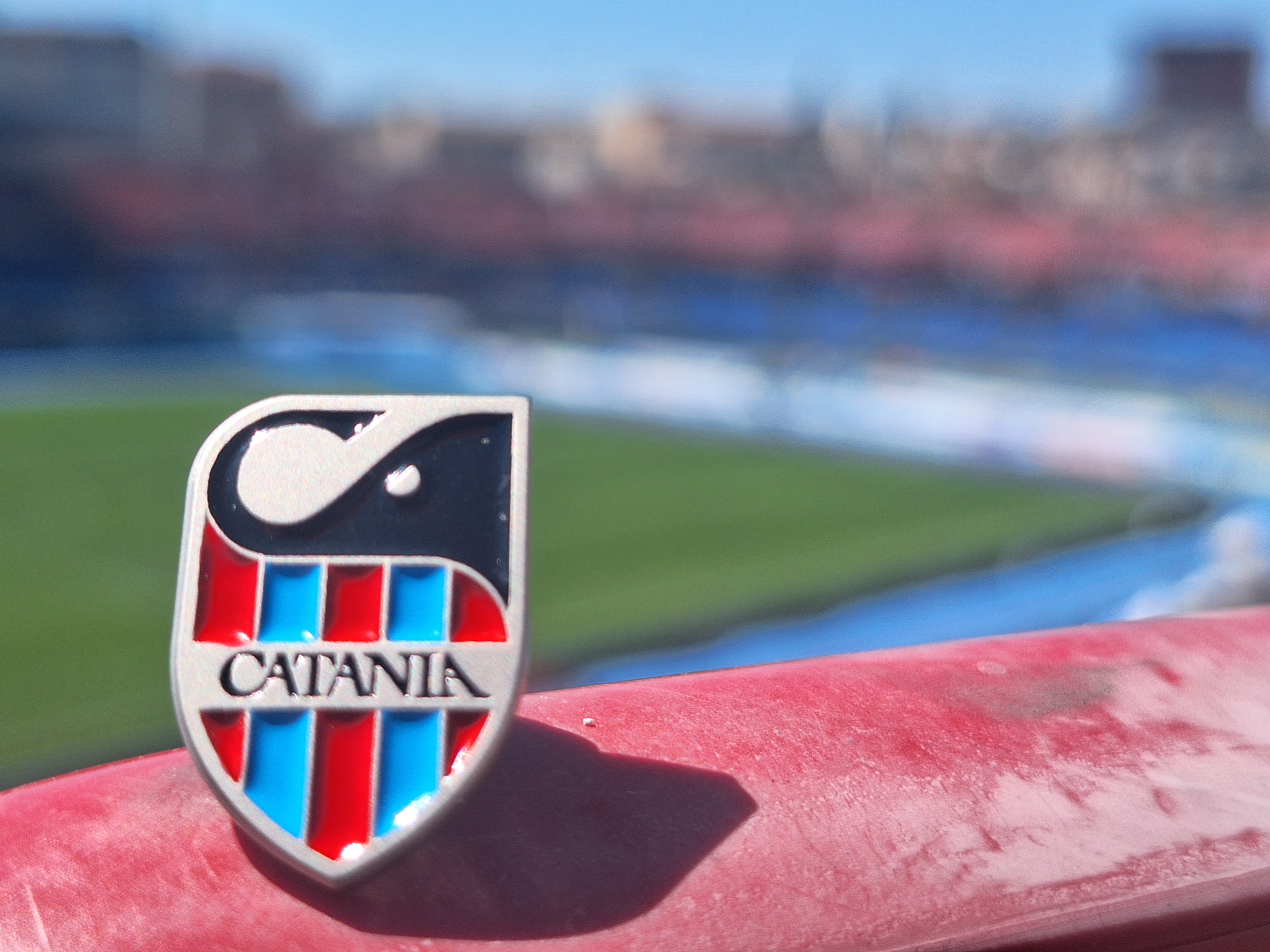
The elephant in Catania isn’t in a room, indeed he/she adorns centre stage in the Piazza del Duomo fountain. The elephant might well have transferred itself onto the Catania Calcio badge, but it started out as the emblem of the city, representing strength and much needed protection given the exceedingly close proximity to Etna. Just to add a volcanic twist to the elephant, it is made of lava stone, with the Egyptian obelisk on its back, the aspect believed to bring protection.
I am sure most readers are conversant with the notion that two league clubs in the UK have an elephant on their badges as well, Coventry City and Dumbarton. I did a little research on these crests and lo and behold, while neither has an obelisk on the back, both are carrying a castle. Disappointingly neither of these, nor indeed Catania are in praise of Hannibal, I guess that must come under review in mainland Europe in the Alpine region. Other elephant badges must exist, Cote D’Ivoire certainly being one! In the case of Coventry (the elephant isn’t as prominent as it was on the ‘80’s badge), but it also represents strength, as well as piety, with the castle a nod to Coventry Castle. I have never been to Coventry, sent or otherwise, so I must confess, the news it had a castle came as a bit of a surprise. A cathedral old and new, yes, but a castle. I think I am needing a trip to Coventry to investigate further.
In Dumbarton on the banks of the River Clyde, it is said that from the Glasgow side of the water while on the M8 as you whizz from Greenock towards the city, if you look across at Dumbarton Rock, it looks like an elephant! That might be why the town has the animal on its crest. The Castle sat upon the badge is found high up on the rock, looking right down on the club’s home park these days. The Sons badge, like the other two, sees the elephant representing strength, at least they can all agree on that, but Dumbarton abandons piety and even protection, going all out with resilience and impregnability no less.
Catania is the seventh city of Italy and the second largest on the island after Palermo. Correlation between population and success on a football field is badly out of line when it comes to this island’s cities, with Palermo the capital, having an equally inadequate number of top flight campaigns on the CV. Cagliari on Sardinia has had much more success than either of the Sicilian giants. Yet, Palermo are now in the City Group of clubs (Man City), and expectations on them are potentially greater than Catania.
The city has just shy of 300,000 inhabitants, and the expectation for its football team is always high. Indeed, that loss at Benevento cost the manager his job, even though the club were comfortably second. Getting to Serie B is the only objective, but that puts undue pressure on the players, and sometimes that can manifest into eleven fit professionals playing like a bunch of elephants!
The city was established in the 8th century by the Greeks, and natural disasters have riddled the history of the city. Lava events from Etna have been frequent, although not Pompei levels, and then earthquakes too have wrecked havoc on the population. Today, its Baroque city centre has UNESCO heritage status, where doesn’t have such accolades these days, but the unusual twist here is that much of the construction has come from lava stone, undoubtedly using what they have available locally.
The Catania elephant, right smack bang in the centre of Piazza Del Duomo, is cheery soul. I defy anyone to have a peek at his smiley face, trunk et al, and not smile back. Here in a nutshell is the Catania vibe, laid back, takes us for what we are. You will find no pretence here.
Like many a city, it has wild contrasts, and if you can forgive the area in and around the train station, things improve dramatically. It is a city truly worthy of a lengthy investigation. Whisper it quietly, but give me Catania over Palermo any day. That said, I am in Catania, I should shout it from the rafters! The fact that the Catania maglia (shirt) is closest of all the football kits of Italy to my club Inverness Caledonian Thistle does not enter my thoughts at all, no, no never! But the blue and red stripes with a whiff of black and white in its mix, the resemblance is uncanny.
I was staying in a very beautiful hotel, the Liberty, in a proper old school Catania building on the edge of the old part of the city. This was exactly the plan, as my previous locations were too near the railway station for my liking. Truly avoid down by the waters edge and the station, especially at night. My hotel’s proximity to the stadium, a mere 20-minute walk, like the shirt story above, purely coincidence, of course!
The Sicilian flag has three legs on a yellow and red halved background, all very Manx if you know your Isle of Man flag! However, having seen many a moggy here, I can confirm that the Sicilian cat does have a tail! Oddly though, without doing excessive research, I can only think of Igea Virtus and maybe Nissa on the island that have those colours. The traditional band of bigger sides, Palermo, Catania, Siracusa, Trapani, Akragas and Acireale don’t venture anywhere near the colours of the island flag.
The Angelo Massimino stadium has more than sufficient capacity to meet the demands of the local’s enthusiasm with a 23,266 capacity. It was built in that classical Mussolini style in 1935 with the now unused running track around the pitch recently covered in bright Catania blue, giving the perimeter of the pitch a striking contrast. The stadium was re-named in 2002 in honour of the clubs former chairman who died in 1996.
The stadium is well looked after. The seating throughout is absolutely fine and clearly numbered, too, a big problem elsewhere in Italy. It has a whiff of Lecce, maybe slightly smaller, but a similarly well-appointed blue running track that might get used occasionally. The irony is that Lecce plays in colours befitting the Sicilian flag!
On a bright, beautiful holiday Monday, the streets of Catania were full of folk enjoying the spring sunshine. Amongst the hoardes, increasing numbers of fans wearing the clubs colours of blue and red. My suitably large club shop bag, pretty full after a morning raid, was drawing smiles, even a high five. How would my ICT shirt go down at Massimino?! It blended in too well is the answer. Maybe the occasional longer look, but let’s face it, who has come across ICT in Sicily!
That all said, the Catania club shop is an emporium that would put many a Serie A team to shame. It’s well stocked, with plenty variety, and judging by those in the queue to buy, a facility popular with tourists with interest in our game. Catania really are a much bigger side than recent history has served them.
The Catania fans are rightly proud of the clubs history and its four stints in Serie A. A significant length of the wall opposite the Tribuna (main stand) has been given over to murals of heroes of yesteryear, but ultimately, like all fan bases who have eaten at the top table, they crave that feeling again.
When this one got underway, Catania looked up for it. A well taken goal was the least they deserved early on. However, Picerno, with their 10 fans, were eyeing up a win to edge closer to safety. They rolled up their sleeves and doubled down on hitting Catania on the counter. Before the half-hour mark, they were level and tickled themselves in front ahead of the break.
Catania controlled almost the entire second period, but they lacked sharpness in the final third, and that fundamental flaw is basically where they came up short. Many times, they got to the bye-line and cut it back. These were either blocked, scuffed, or saved. However, one did beat the keeper, but a Picerno lad was on the line to knock it clear. It ended 1-2, a fifth Catania game viewed for me, all with that score.
The Basilicata side were struggling earlier in the season, but Signore Curcio perhaps did a little January trading to bolster the side, as they have really kicked on. Organisation and teamwork were the ethics that got them a win here, as well as determination. Catania are going to need to find that sort of formula quickly. They looked a good team at Benevento, who were promoted, deservedly on the back of this loss by the Elephants. The new manager bounce has been no existent, and judging by the volleys of abuse from the Ultras in both Curvas, things aren’t in the right place to make a fist of the playoffs. That big-time pressure for clubs of a certain perceived stature when underperforming, especially when money has been spent, just adds another layer to making life even more difficult.
Sant’Agata is a Saint wrangled over by Palermo and Catania as to being their very own. In early February, Catania celebrates three days to their patron. You know what’s coming, Agata = Agatha, as in Christie, and quite why Catania can’t find the winning formula to get them at least back to Serie B, well, it truly is a mystery. While it will likely remain unsolved for another season on the football fields of Southern Italy, Catania is well worth a visit if you have the time.
GETTING THERE
The Stadio Angelo Massimino is easily accessed from the centre of the city, about 1.5 kilometres, largely gently uphill, but not an unpleasant walk. While it is just over 3 kilometres from the seaside main Catania Centrale stazione (station), it is easily achieved if you are daytripping from those fabulous coastal resorts Taormina or Siracusa.

