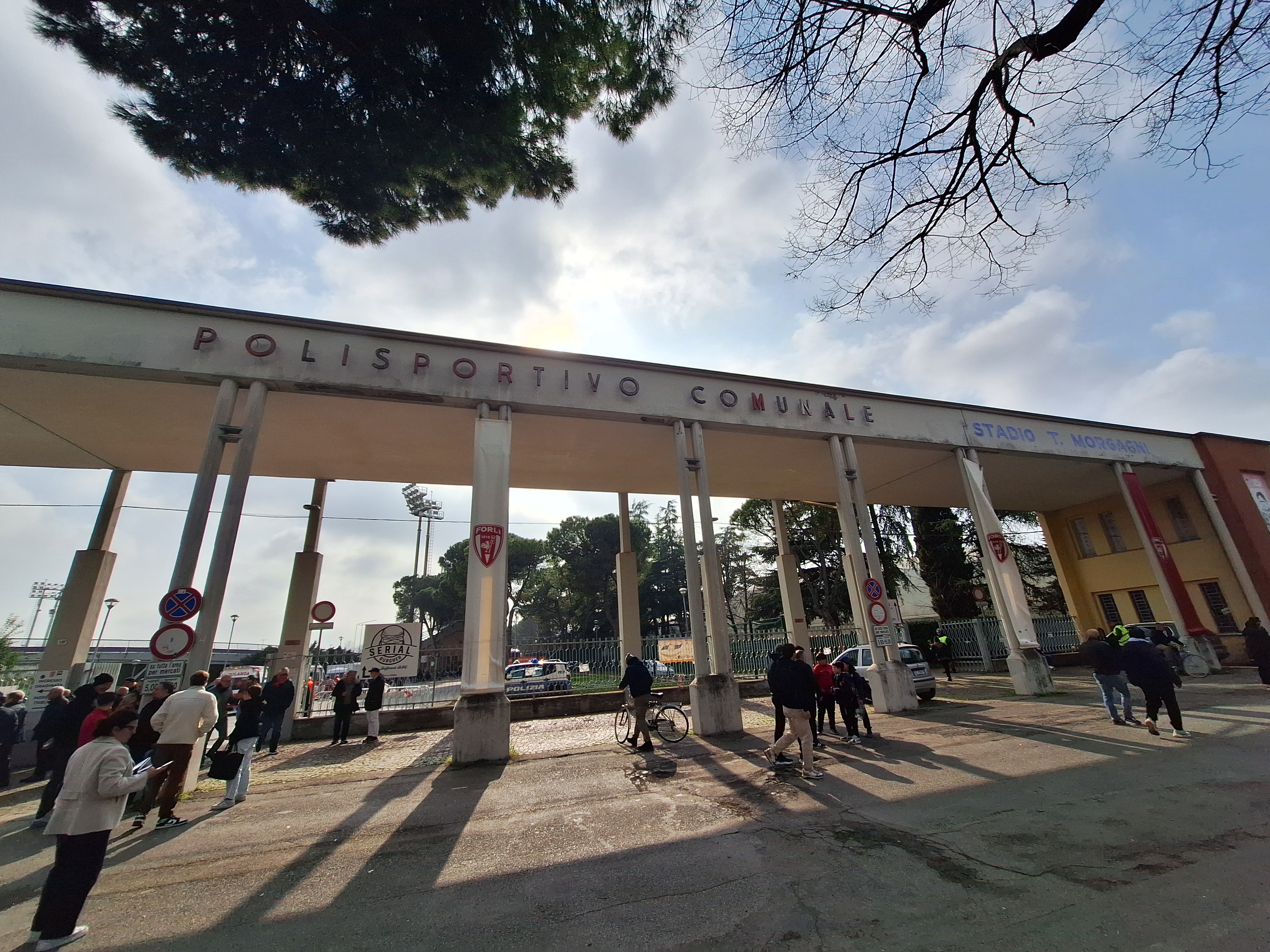
Forlì, once before featured in FW magazine, part of a region wide overview after my two matches here in April 2017. Emilia Romagna is home territory for Forlì, and one of the most prosperous areas of Italy, especially those cities from Bologna headed north. Here, it is a hotbed of famous Italian exports, from cars and balsamic oil in Modena, not forgetting Luciano Pavarotti as well, to the shared responsibility of hard grating cheese and cured hams of Reggio Emilia and Parma. Bologna, the capital is, of course, a culinary hotbed and doubtlessly the star attraction of the region. Everyone of the aforementioned places has one club or two, in the case of Reggio Emilia (Reggiana and Sassuolo), in the top two tiers.
A small knot of readers, who ventured on FW’s sole Italian escapade thus far, might still suffer shivers down the spine of the absolute Sunday drivel they were dragged to in Fiorenzuola D’Arda. A sleepy hamlet at best, on the most northern fringe of Emilia-Romagna. While this small crowd gig, with an equally tedious match wasn’t what everyone was looking for that day, it remains a high water mark in my world of supporting Ancona, as it is still my only away win witnessed to date. Almost exclusively for the band of men present that day, Fiorenzuola have fallen two levels since, and are now sitting second in the regional Eccellenza, the fifth tier. Probably about their level.
South of Bologna, the famous crops and cars kind of dry up, but these are still prosperous places. Imola is well known in F1 circles, with Imolese playing right beside the circuit. Next along the line headed south towards Cesena and Rimini is our featured club, Forlì.
Forlì, which is pronounced as “For Lee” with the emphasis on the ‘ì’ at the end, due to the wee inflex, that isn’t merely a dot.
Back in the spring of 2017, matches versus Maceratese and Bassano Virtus (now part of Lanerossi Vicenza) were both lost in the space of a couple of weeks by Forlì, as indeed, soon after was the club’s third tier status. They were managed at the time by an Ancona legend, Massimo Gadda. It was largely his dugout appearances that encouraged my visits. Alas, he was shortly afterwards gone. He did pop up as Ancona boss last season, but it didn’t work out, even having his old boss Vincenzo Guerini as figurehead Chairman of a new club takeover. That old adage, never go back, is perhaps true in this circumstance.
Forlì stayed away from the third tier after 2017 for 8 campaigns, dotting around in Serie D without looking likely to threaten. That was, until last term, when they took a very strong Girone by storm, eclipsing more established names like Piacenza, Ravenna, Pistoiese, and Prato to win the title quite easily. That winning habit hasn’t quite propelled them as high as Ravenna this term, though. The fellow, coastal Emilia Romagnan side, won the Coppa Italia D last season, thereby qualifying them to sit fairly high in the ranking table from where the FIGC, the football authorities go fishing for replacement clubs when clubs go bust (Rimini mid-season this term), or fail to pay the necessary bond to join for a new campaign.
A bit like any club, or indeed country that is given a late reprieve or chance, Ravenna have astonished this term, sitting second as I write, and looking well placed for a last 8 slot when the playoffs come around. Forlì might well be joining in those playoffs, but if they do achieve it, they’ll have at least three rounds to play before Ravenna gets involved. Forlì are on the cusp of 10th, the lowest qualification position available, which would send them on a one-off away day to whoever finishes 5th in round one. As luck would have it, the visitors when I paid my third visit to Forlì were Livorno, a side just above them in the table and with games running out, it was a classic case of all to play for in this one.
Forlì has a sizable population of 116,700, nearly 50,000 more than neighbouring Cesena. Yet, I am sure most readers are familiar with Cesena, but not so much Forlì. It is a classic case of population not equating to anything worthy of the number in terms of footballing success. Indeed, when you also consider the old velodrome stadium in the city, Stadio Tullo Margagni only holds 3,385, compared to Cesena’s 20,000, nearly a third of the population, it all seems out of synchronicity.
Forlì sits on the old Roman way Via Emilia, which helped establish it as a prosperous dwelling and trading city on the Roman road. It has over the centuries been a place of learning, and excellence in the arts and science, which might partly explain why its football team has rarely been above the third tier. Today, like Cesena, it is home to some of the extensive campus of the University of Bologna, which adds a youthful feel to its streets on “school days”.
The centre of the city is delightful, with many fine buildings, none more so than the municipal palace (Palazzo Municipale). The city gate, the old Roman entry point, Porta Schiavonia, is worthy of viewing. There is also a fort, Rocco di Ravaldino, an imposing fortification, lending further evidence to the need to defend yourself back in the day. It is a state of mind that hasn’t entirely left the Italian psyche. Those neo-fascist Mussolini constructs are everywhere too, giving it just a slightly different feel to any city in the near vicinity, and constantly sparking a Heaven 17 song in my mind as I walked around! Forlì is also a very green city with large parklands in which to escape the maddening crowd. Resistance Park certainly gets the mind whirring as to why it was so named!
The walk from the main square to the stadium is less than 20 minutes, pretty much in a straight line. A velodrome venue is something that still exists in many places, especially northern parts. It’s almost undetectable at Como now, but the Sinigaglia was a velodrome, as was the Martelli stadium in Mantova. Also in Lombardia, a club still sitting on my ever decreasing list to bring to light, Varese, who were once a ‘big’ club, and whose stadium has perhaps one the best preserved as a velodrome in the country. Along with Forlì in C, Carpi was a velodrome, easily spotted where the away fans are housed there. Forlì’s venue is still a working velodrome, a real cycling gem, like Varese. It has no Curva for fans at either end, merely the high sided curves for the cyclists. This area of Emilia-Romagna is classic cycling territory, with Marco Pantani, a native of Cesena. Further down the pecking order, Pordenone in Fruilia was also a velodrome and whisper it quietly for those who ventured there, so was Fiorenzuola!
The flat land nature of this area, lends itself well to cycling. Commendably the local planners have gone to town on fine cycle lanes. However, when the mere walker is forced onto a thin slither of ruffled tarmac, or abandoned completely, it’s not on. At times the line between what is for peddles and what is for feet is blurred. Headed out to the stadium, an elderly cycling lady absolutely berated me in a loud voice, “posso” (can I) she shouted having stopped to lecture me. It should be pointed out at this particular juncture, the path was wide enough for an entire peleton. It was an angry outburst, a portent of things to come!
i Galleti, the cockerels (offering Spurs fans a quick opportunity to change allegiance!) as Forlì are known, is a nickname doubtlessly taken from the club badge. They have been going since 1919. Originally known as Foot-Ball Club Forli, the club did make Serie B, but it was last graced in 1947 just after WWII. However, that modern malaise, the art of bankruptcy came visiting upon relegation for Serie D in 2005/06, and the snake led them from the 4th tier all the way down to the 9th level! Quite a dramatic fall. Having made it to the third tier when I was visiting 11 years later was no mean feat, but Serie C seems to be the club’s glass ceiling. That said, the facilities are not B acceptable, and maybe dotting along in the third tier is as good as is required in this laidback city.
I am unsure why Forlì can’t draw a crowd, save the proximity of Bologna and Cesena, and while it was doubtlessly frowned on back in the day, the nature of modern allegiances might see these clubs, who have more ambitious intent, enticing fans north or south of Forlì in search of mild gloryhunting. I use the term mild, because let’s face it, save Bologna winning the Coppa Italia in 2025, the region isn’t renowned for bringing in the silverware. Having said all that, such cases of allegiance changing will be rare. Italy is exceptionally territorial, where near neighbours are viewed with suspicion. Largely, everyone supports a big A side and the local side, not the team, within 30 minutes of travel. But here, Forlì struggles to get four figure crowds.
The exceedingly small band of Forlì Ultras, ranging from around 8 years old to a chain smoking, gravel voiced 70 something, doubtlessly from the Vecchia Brigate (The old brigade). At one point he grabbed the megaphone, which in itself was unnecessary to make yourself known to 20 hardy fans, and blurted out half an answer to who Forlì doesn’t like. Bologna, Rimini and Ravenna were given it large. That might suggest, given this area is known as Forlì-Cesena, the latter aforementioned side from Serie B are acceptable part of the fabric of calcio in the area.
This outburst was in stark contrast to the Curva Nord, Ancona the night before, where the chums were celebrated, and for once Ascoli were left high and dry, off roster!
It was a lunchtime kick off for the visit of Livorno, one of the great clubs of Italy. They certainly have a certain fame, perhaps largely due to their fans. Unlike attention seeking left-wing clubs in other lands, Livorno just go about their business and leave the fawning to those who fall under their spell. That said, unlike a description in one dreadful rag of a book on left wing politics in football, where seeing a Celtic shirt is allegedly an endorsement of left wing thinking (in Scotland that’s not the immediate thinking!), the author skipped over Livorno and headed for Cosenza, suggesting they were too far to the left, almost maoist! The true reality of the tawdry text was that Livorno were far down the pecking order in the Tuscan Eccellenza at the time, and he probably didn’t even know how to source fixture information.
Livorno has only recently risen from the fifth tier to the third, just promoted along with Forli last season. Both took part in the end of season competition to decide the best of the 9 promoted league winners last term. Livorno won that particular honour and now have an Italian flag shield on their shirt in acknowledgement this season, but like Forlì, they have struggled to get a grip on Serie C life. That said, they have chippered up and moved away from the relegation zone to look upwards and, together with the hosts, are attempting to claim that last promotion play off slot.
Despite a paltry crowd, Livorno fans were banned from travelling. Just don’t get me started on this dreadful new malaise in Italy, where they have seen it work in Argentina and largely see policing costs significantly reduced, etc. That said, sometimes it isn’t even the clubs who have the final say. At less than 48 hours’ notice, Campania region banned Catania fans from heading north for a huge game at Benevento. Not only were 1400 away tickets sold, they would have all arranged transportation, maybe even accommodation, given a 20,30 kick-off on a Thursday night. It’s utterly disrespectful and eroding the rights of human beings. Despite what the powers that be might think, that’s what fans are!
This game set off at a cracking pace. Both sides had early comedy defending gaffs, but they survived those. A VAR request card was handed over after a potential last man tripping by a Livorno defender. A lengthy stoppage ensued, perhaps giving the free kick taker more than enough time to get his sights right. No red was forthcoming, rightly so, but Forlì’s distress about that was immediately forgotten as a fabulous effort into the top left corner, over the wall, beat the keeper all ends up.
Livorno were never out of things, and just ahead of half-time, intricate work on the left saw a cut back practically from the bye-line, and it was all square. It was at this point I started to question those around me, were they all related to my angry cycling lady?! Rarely were they happy, and every decision or tackle was met with hurls of abuse, with every word elongated and spouted in an awful tone. Maybe they manage 200 folk at work and just have to vent the pent-up anger. I made a decision to move for the second half.
It all became a bit humdrum after the break. Both sides were trying, but no one could fashion a glaring opportunity. The sun making an appearance had seemingly slowed things down. That said, if the goal posts had been slightly to the right, the Livorno number 9 might have had a hat-trick! He fizzed the ball just by the upright three times in the second half.
A point keeps both sides eyeing up those playoff places. With Pisa heading back to B, Livorno would dearly love to catch them up again, finally. For Forlì, just surviving is undoubtedly a result. It’s a lovely city, but why they struggle to get people in the door, truly is a mystery.

