If you played football at primary school, do you recall the first colours you donned to play? My first colours were green and black taken from the school crest. We used to play in a striped shirt with this combination, but we went radical one season when the coach/teacher ordered us the Borussia Monchengladbach shirt of the day, essentially white with a central green stripe and two black ones either side. We thought we were world beaters playing in that shirt, but invariably no matter what the kit, we seemed to struggle.
Green and black stripes are a rare thing in the UK, not desperately common anywhere as far as I am aware. Nuevo Chicago gets a sympathetic perusal of results from me in Argentina having been to Mataderos to see them play, where I bought my first post primary school green and black striped shirt! The wonderfully named El Tanque Sisley from Carrasco Norte in Montevideo are similarly attired and followed by me, especially since I have seen them four times, albeit they have yet to score a goal when I am in the Cancha (South American for stadium). Oddly, Nueva Chicago came up blank as well, there is a bit of a theme developing here. Indeed, it took until November 2019 and a third team, on its second attempt, in my 7th game involving this colour combo for one of them to finally celebrate a goal, more later!
Italy has for whatever reason a slightly greater leaning towards the green and black with Serie B boys Pordenone, little Chieti and Sassuolo immediately springing to mind. This is the tale of the latter, the Neroverdi (black and green) of a wee team made good. They are one of only half a dozen clubs throughout the entire Serie A history that didn’t belong to a provincial city. Now that’s a question for il tifoso appassionato (the passionate fan) of Calcio, who can name any of the other five? Answer at the end of this article.
In the case of US Sassuolo, they will for sure be the only one of that six to own their stadium. Remarkably only 4 of the 18 clubs in Serie A do own stadia, and even those four are relatively recent. Juventus and Udinese, oddly the two black and white striped kits of the top flight were the first. More recently they were joined by Atalanta in Bergamo, whose upgrading efforts have seen the slick, exciting Lombardian outfit required to play European ties for the last few seasons in Milan, but before that, the fans were asked to head the considerable distance down to Reggio Emilia, the home of the 4th owned stadium team at Stadio Mapei, or Città del Tricolore without sponsorship. This is the home of US Sassuolo, a very well run outfit from the small town of the same name who have really made their mark on the Italian game. They essentially bought Stadio Giglio off the Reggio city council, which was home of a much bigger club in Reggiana, or Reggio Audace as they seem to have temporarily become known following bankruptcy. Sassuolo now let the stadium to them on match days.
I used to think of myself as a traditionalist, where I wouldn’t take very well to newer clubs beating the old school teams of yesteryear to places higher up the pecking order in any league. In England, the London and South brigade seem to have found the necessary finance to get into the league system easier than potential returning sleeping “giants” like Wrexham, Stockport and Notts County etc. However, I am delighted to see a 1970’s wrong righted with Barrow back in the fold, ironically almost voted in 50 years after controversially being voted out. Italian clubs have a certain notoriety when it comes to poor fiscal management leading ultimately to going bust, and given the Covid situation I shudder just how many clubs might fold in the coming months. The well run smaller clubs deserve their place though, times move on, and I think the opening up of the Scottish league to a pyramid system of sorts has helped alter my thinking, although the Covid closure of that route for 2019/20 speaks volumes as to how welcome well organised and financially astute newcomers are in reality, sadly.
With a population of just over 40,000 Sassuolo is easily the smallest town involved in Serie A. Until the club debuted in Serie B in 2008, the 4,000 capacity Stadio Enzo Ricci in the town hosted the steady progress of this provincial club. The Ricci is now used as the training facility, helping retain a genuine connection with the town as they’ve “technically” been on the road for 12 years, and given they now own their stadium, I suspect they have no plans to ever move back to Sassuolo, unless it all went pear-shaped. Geographically Sassuolo is closer to Modena, and it was here they first moved as a base in 2008. However, this ambitious club had designs on owning its own place, and courtesy of Mapei, the parent company/owners, they purchased and started to develop the Reggio stadium in 2013/14, which happily coincided with Sassuolo being promoted to Serie A for the first time. The region had a bit of a log jam of small clubs needing bigger stadia at the time, with Reggiana ceding to Sassuolo, and Carpi moving into Modena while the hosts both struggled in lower leagues. Both Modena and Reggiana went bust in the spring/summer of 2017, but are now back in the third tier, where Carpi have now fallen back too as well following the clubs solitary Serie A campaign, and are now using their own redeveloped ground back in Carpi. Sassuolo really don’t really do relegation, the CV is blighted with just two demotions, the first of which in 1968 from the 4th tier sparked a merger with a number of other local sides, where the pooling of resources created a greater sum of its parts outfit ready for the next chapter. In 1990 when they were relegated for the last time, once again from the 4th tier Serie C2 to Serie D (now the 4th tier), also known then as Interregionale, they found this a very tough tier to get out of, after all with just one promotion place per league it’s not easy. It took Sassuolo almost a decade to get out of that division, but since 1998 the only way has been up. The progress has been steady, maybe unspectacular, but the right bricks are laid at each level to allow the club to prosper.
Sassuolo’s football history dates back to 1920, but they were merely a regional league amateur side, but even merging with the other local clubs in the late ‘60’s, no one could have foreseen that this team would one day be representing Italy in Europe. That is exactly what happened, and in 2016/17 they debuted in the Europa League against Luzern having finished 6th in the top flight the season before, finishing above the likes of AC Milan and Lazio, and claiming famous scalps of Napoli, Juve and Inter along the way! Luzern were dispatched 4,1 on aggregate, as were Red Star Belgrade with identical scores, 3-0 at home and a 1-1 draw away. That brought them into the group stages, where failure to pick up any points versus Belgian side Genk saw them fail to progress, but Atletico Bilbao were given one of those 3-0 thrashings in Reggio.
Stadio Mapei, is also known as Citta del Tricolore when sponsorship can’t be used, and has been developed into a fabulous facility. Underneath the stand opposite the main one, you’ll find a shopping mall, as well as a leisure centre complete with a multiplex cinema and a variety of restaurants. In the corner behind the electronic scoreboard a huge gym can also be found. All of these facilities are open daily, and still function when a game is taking place, with the bars and eateries especially popular with the fans pre and post match. With a capacity of 23,717 the stadium is more than adequate in size to accommodate fans even for the bigger visiting teams. Rarely would a Sassuolo game sell out, but as they continue to show ambition the fan base also continues to grow, albeit starting from a modest base. The club’s stadium is 33 kilometres from Sassuolo, so it’s a big ask for the fans, and while they continue in Serie A all is well, but should they suffer a first demotion from the top flight, that would be the first real challenge in terms of fan base and finance. That said, they’ve rarely ever looked like getting caught up in any relegation fight thus far.
The name Citta del Tricolore comes from the host city Reggio Emilia, where the Italian flag was born. Reggio is more than four times the size of Sassuolo, and its own team Reggiana have traditionally been a well supported outfit. The stadium is on the Eastern outskirts of the city, about 3 miles from the regular railway station. I use the word regular because more recently Reggio Emilia has opened a high speed railway station Mediopadana, and access from this stop isn’t only a whirlwind quicker trip from Milan or Bologna up or down the tracks, it is considerably closer to the stadium, perhaps 1 ½ miles via a route under the motorway and along a road predominantly housing business units.
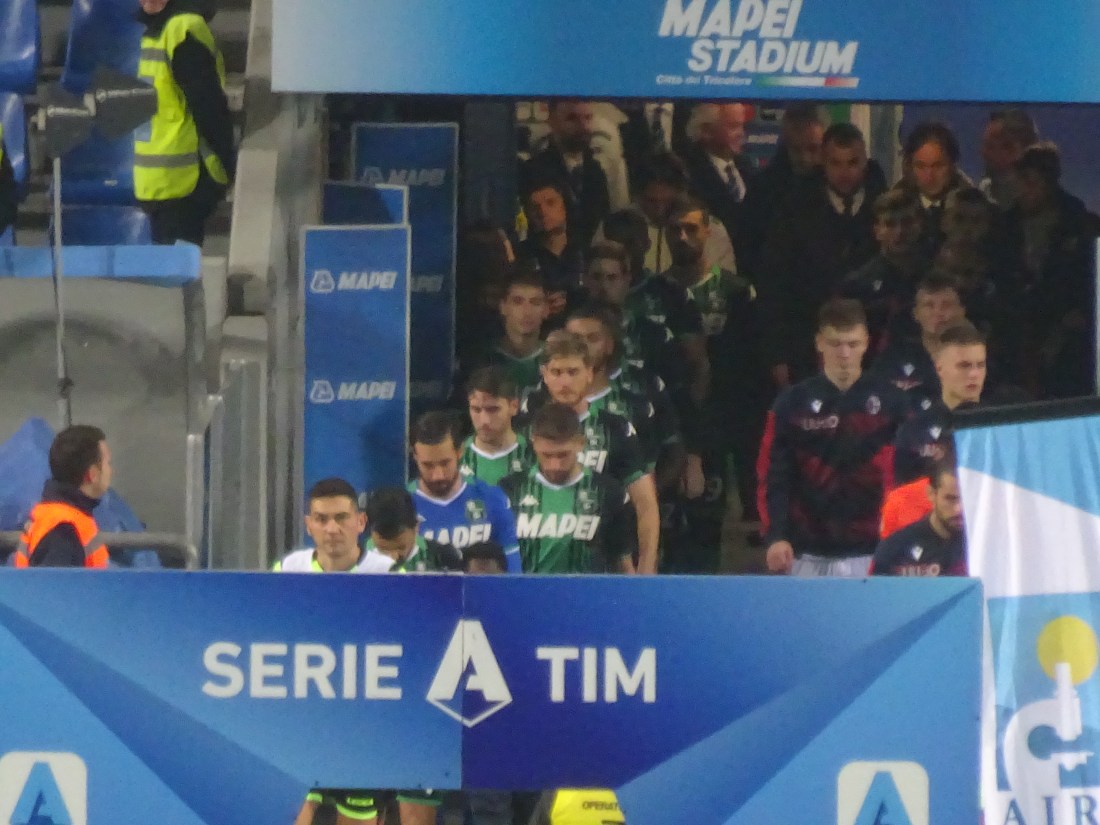
I have had the pleasure of seeing three games in the Mapei, on the first two occasions I approached the stadium from the city, but most recently in November 2019 I chose to arrive from Milan on the high speed link with a journey time of just 25 minutes. This was a night game, and I had booked the Holiday Inn just ten minutes from the stadium. Such is the dearth of bars and restaurants in the vicinity, aside from in the shopping mall under the stadium, a group of Sassuolo fans were gathered in the modest hotel bar eagerly anticipating this Friday night “derby” against the region’s capital side Bologna.
When Covid brought an unexpected end to all our 2019/20 roster of games I was on 99, going out on a 1,7 Cove Rangers win at Stirling just a day or two before being denied the opportunity of hitting the 100 at Arbroath. It would have been only my second haul of a century of games, but it wasn’t going to happen sadly. Upon reflection of my entire 99 game listing, the game of the season came that November night in Reggio Emilia. My previous Sassuolo home game had been an entertaining, if goalless draw with Sampdoria, but this one was an altogether more fabulous, high tempo, end to end affair.
I have long been a fan of Sinisa Mihajlovic, and given his ongoing battle with Leukemia I was especially keen to watch his team play, but watching from a purely neutral perspective, as a Cesena/SPAL sympathiser could never unduly cheer for Bologna! Sinisa ultimately had been advised to stay away following his recent round of chemotherapy, but a wonderful banner and chants from the sizable away following showed how high a regard the Serbian is held.
Unfortunately, no matter where he was watching this one, his blood pressure would have risen considerably as Sassuolo set about his charges with threatening glee right from the kick off. The speed and openness of the game was unusual for an Italian game, and it just got better and better as the game progressed. Trailing by a goal at half-time, Bologna came out after the break more determined to match Sassuolo’s open style, and it led to the most entertaining end to end 45 minutes. A lightning fast break put Sassuolo 2-0 up, but within minutes the visitors had halved the arrears, but they merely stung the home side into greater efforts as within five minutes Caputo drilled home his second and despite continuing to pour forward, Bologna were capute 3-1!
When you are staying just ten minutes from the venue there is no need to rush away, and watching everyone file out ahead of me was very relaxing. That is the very word, relaxing is how I would describe the Sassuolo match day experience. They have a piddly wee gang of lads who endeavour to subscribe to the Ultras code, but by and large this is a family club. You see whole families, young and old enjoying the game, showing passion where merited, but it doesn’t have that cutting edge atmosphere or any sense that it could all spill over any moment. The away end was more voluble throughout, and despite the result the fans were clearly right behind the team, which is always good to see.
Back in the hotel bar I was the last of the pre game quaffers to grab una pinta (a pint), and finally reveal my Nueva Chicago shirt to the locals. The Argentine side might have a few more followers now! These Sassuolo fans were from the town itself and they park their car near the hotel for ease of getting away when traffic is heavy, and so after that one drink and a few tales of how they still feel like they are living a dream, they sped off into the warm November night.
Sandwiched between my two Sassuolo games at the Mapei came a visit for a third tier game between Reggiana and Sambenedettese in September 2017. I was keen to see the true ‘home’ team, and sample a perhaps a more traditional Reggio Emilia afternoon at the football. The Curva Ovest, home to the Sassuolo faithful is also used by the Reggiana hardcore, and they bring to the party an altogether more atmospheric repertoire of song, sizeable flag and the occasional flare. Despite the distance, a good number of Samb fans had travelled north from San Benedetto del Tronto on the southern coast of the Marche region, and in their midst was the most amusing banner “futili motivi, (futile motive), which maybe sums up the infuriatingly slow progress of Samb in a humourous way. You are truly a dedicated fan travelling vast distances to away games in Italy, like any large country. Perhaps a bit like Reggiana, both sets of fans have a greater sense of grandeur than is necessarily founded. In the case of Reggiana however, at least they can point to the occasional top flight campaign. With a crackling atmosphere the game served up another Mapei thriller, a 2-2 draw was shaken upon at the final whistle as both clubs continued their Serie C life, but by season’s end I guess no one could have foreseen the home side going bust.
Reggio Emilia is not a bad base to tour from, with cheaper hotel accommodations than Bologna, and the ability to plunder Piacenza, Parma, Modena or Bologna, as well as a having two alternative teams on offer in the city for football, let alone being in one of the great culinary areas of the world, let alone Italy.
How did you get on with the other five “town” representatives in Serie A over the years? Carpi, Empoli, Casale, Pro Patria and Legnano, the last three are really tricky, so if you got any, well done.
 Football Adventures with James Rendall